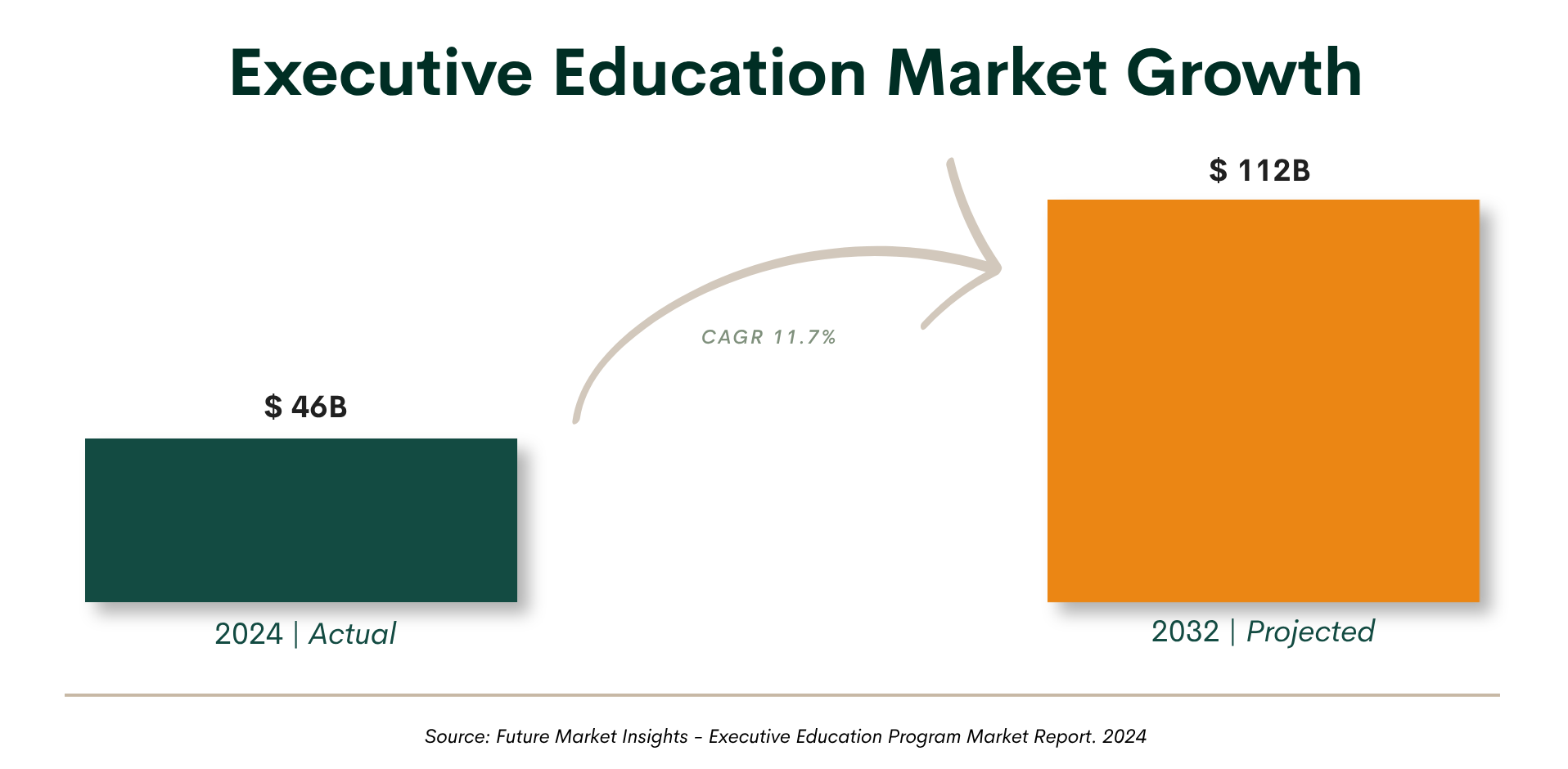
The executive education market is expanding rapidly. Valued at USD 46 billion in 2024, it is projected to reach USD 112 billion by 2032, driven by accelerating demand for leadership development, professional upskilling, and the globalisation of corporate learning.
For executive education providers — whether standalone institutes, business school departments, or corporate learning organisations — this growth brings a specific challenge: how do you differentiate yourself in a market where every provider uses the same language (world-class faculty, transformational learning, real-world application) and competes for the same corporate clients?
Part of the answer is programme quality. But a large part — one that is systematically underestimated — is how you present yourself digitally. Premium positioning is not claimed through copy. It is built through the quality, coherence, and precision of everything a prospective client encounters before they ever enter a room.
The credibility challenge specific to executive education
Executive education operates in a high-trust, high-stakes environment. Corporate clients are not buying a product. They are investing in the development of their senior leadership, and the decision is both strategic and personal. The cost of a leadership programme can range from a few thousand to tens of thousands of euros per participant, and mistakes carry real consequences.
This means the decision to engage with a provider involves more scrutiny than most B2B purchases.
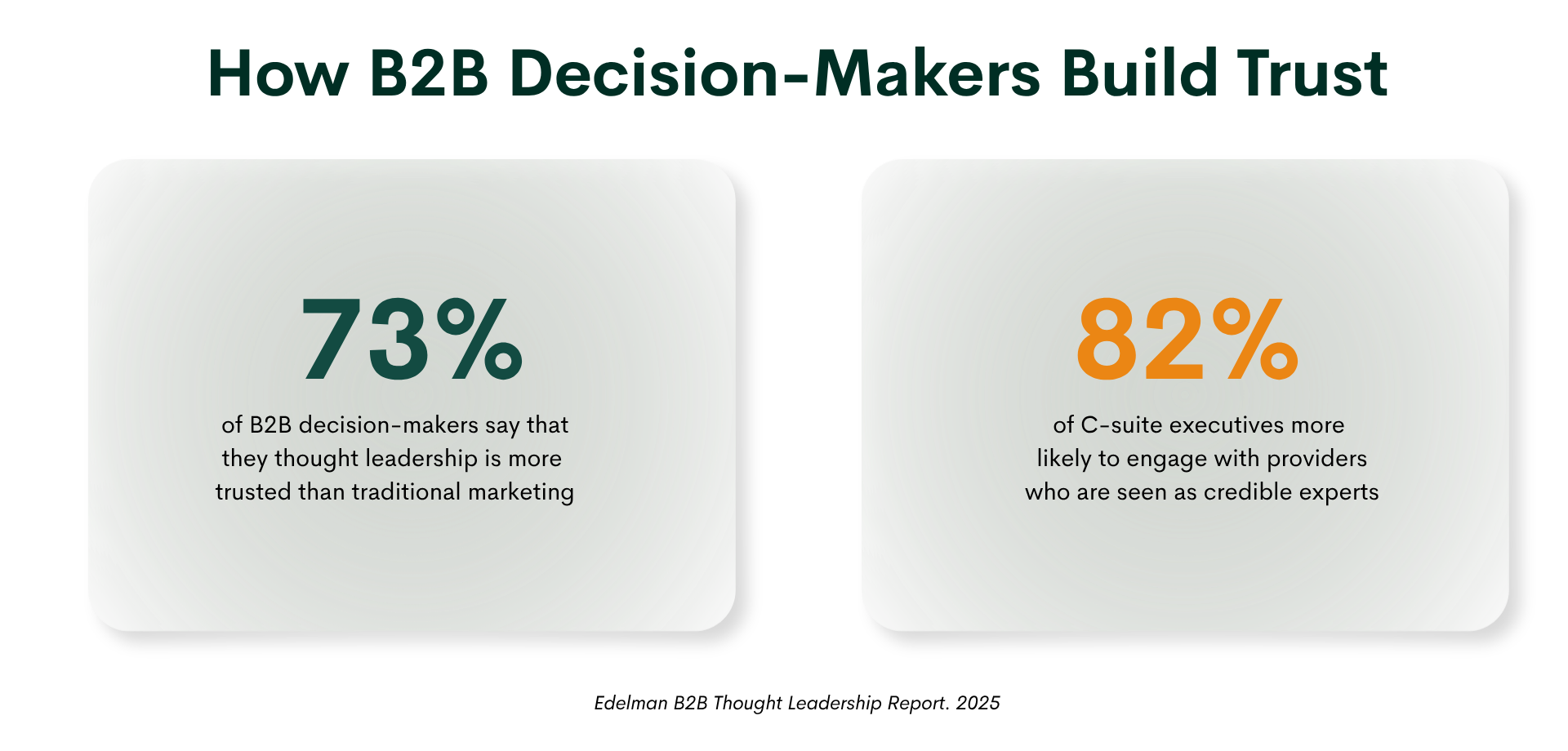
73%
of B2B decision-makers say thought leadership is a more trustworthy way to assess capabilities than traditional marketing
Edelman B2B Thought Leadership Impact Report, 2025
And 82% of C-suite executives say they are more likely to engage with a provider they consider a credible expert. In executive education, credibility is not established by claiming expertise. It is established by demonstrating it — through the quality, structure, and consistency of everything a prospect encounters.
What corporate clients evaluate before committing
The evaluation of an executive education provider by a corporate learning director or HR executive is thorough. Before a first conversation, a serious prospect will have reviewed:
- The provider’s website, including faculty profiles, programme pages, and client or alumni information
- Programme brochures and downloadable materials
- Case studies or impact reports, if available
- LinkedIn presence and published content from the organisation and its faculty
- Visual and tonal quality of all communications — from email to event invitations
Research consistently shows that 75% of users judge credibility based on website design, and that first impressions form in milliseconds. For executive education providers, where the brand must simultaneously signal academic rigour, real-world relevance, and premium positioning, the visual execution carries extraordinary weight.
The elements of a premium digital presence for executive education
Premium digital presence in executive education is not about looking expensive. It is about communicating precision, clarity, and institutional authority. The providers that achieve this share certain characteristics.
Clear website architecture.
Corporate clients can find what they need quickly: programme structure, faculty credentials, learning outcomes, delivery format, and how to engage. Navigation is logical. Information is layered — enough to build confidence without overwhelming.
Restrained visual identity.
The strongest executive education brands do not compete with consumer brands on visual excitement. They signal seriousness through restraint: a controlled colour palette, precise typography, structured layouts. The visual language communicates institutional weight without needing to shout.
Content that demonstrates expertise.
Articles, reports, and insights published under the organisation’s name contribute genuinely to the professional discourse of the sectors they serve. According to the 2025 Edelman report, content quality and intellectual rigour directly influence a decision-maker’s willingness to engage.
Programme materials as brand touchpoints
One area that executive education providers consistently underestimate is the role of programme materials — workbooks, slide decks, handouts, pre-reading packs, certificates — in shaping the participant and client experience.
These materials are not peripheral to the brand. For many participants, they are the primary physical or digital artefact of the programme. Well-designed, coherently branded materials reinforce the quality of the learning experience. Poor or inconsistent materials undermine it — regardless of how strong the facilitation was.
For corporate clients who send multiple participants or run co-branded programmes, the quality of materials is also a direct reflection on their own internal standards. When an organisation invests in external executive education, the materials their leaders carry into the room — and back to their teams — carry the client’s implicit endorsement.
Executive education providers who take this seriously treat every material as a brand decision: consistent typography, structured information hierarchy, appropriate use of visual elements, and clear alignment with the overall institutional identity.
From first click to programme completion: the full brand experience
The most effective executive education brands think about the participant journey as a continuous brand experience — not a series of disconnected interactions.
A prospective participant, or the organisation sponsoring them, encounters the website. They download a programme brochure. They receive an enrolment confirmation. They attend the opening session and receive their materials. They complete the programme and receive their certificate. They may receive alumni follow-up or continuing content.
Each of these is an opportunity to reinforce — or undermine — the sense of institutional quality and care. When they are visually and tonally coherent, participants experience something that feels complete. When they are not, the gaps create a subconscious sense of inconsistency that affects how the learning experience is remembered, evaluated, and recommended.
In a market where referral, alumni reputation, and corporate client retention drive long-term growth, that overall experience matters as much as the curriculum itself.