

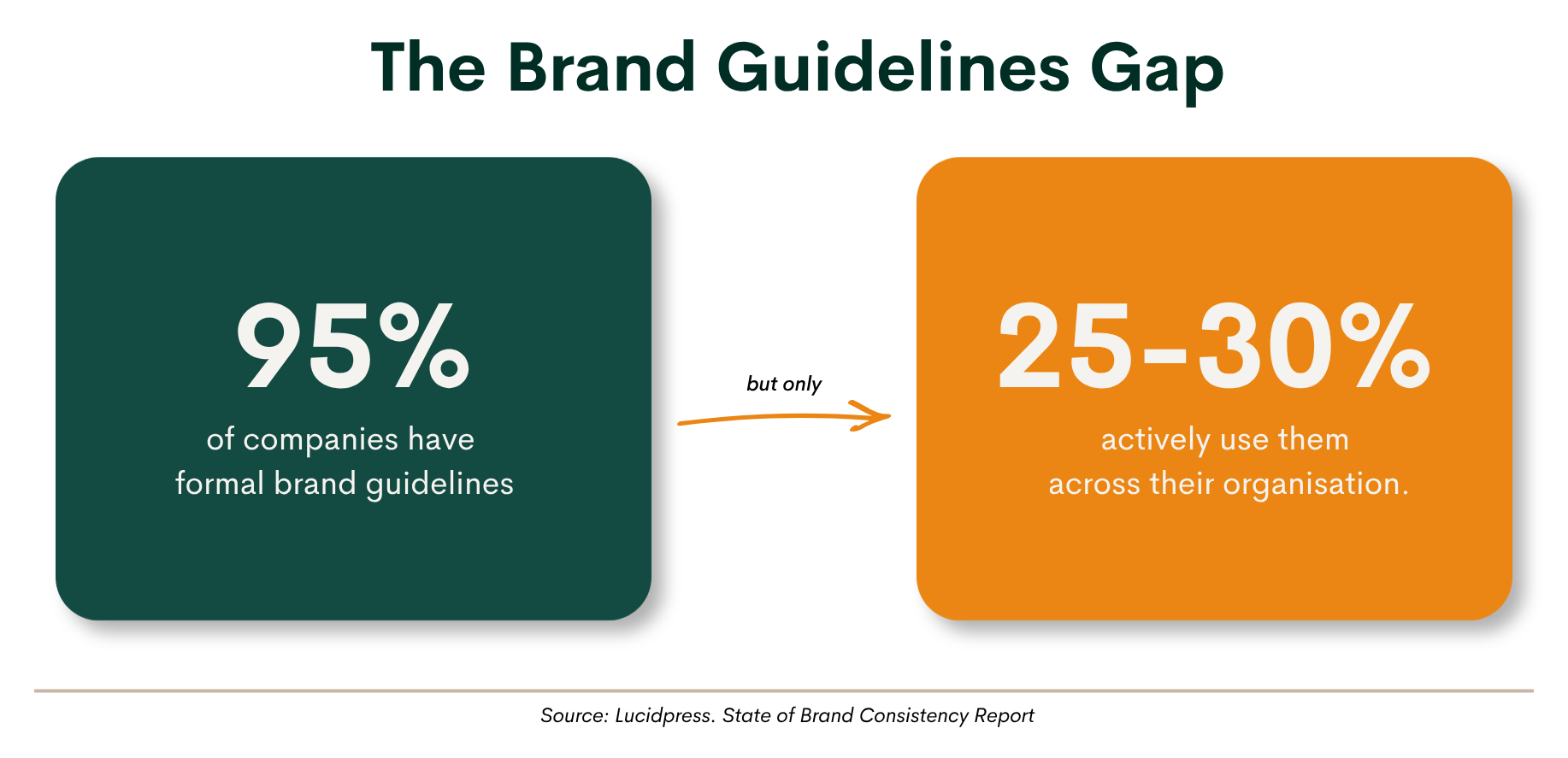
There is a statistic that appears across virtually every brand consistency report, and it is genuinely striking: 95% of companies have formal brand guidelines. But only 25 to 30% actively use them across their organisation.
That gap — between having standards and applying them — explains why so many professional services firms feel fragmented in their communications: proposals that look different from the website, presentations that bear no visual relationship to printed materials, social posts that could have come from a different organisation entirely. The guidelines exist. The system does not.
This article is about what brand consistency actually means in a professional services context — not in theory, but in practice, across the real materials a firm produces every day.
Most firms understand brand identity. It is the visible layer: logo, colour palette, typography, perhaps a set of icons or a photography style. Brand identity is the answer to the question: what does our brand look like?
A brand system is something different. It is the answer to a different question: how does our brand behave across everything we produce?
A brand system is the logic behind the visual elements. It defines not just what fonts to use, but how they are applied in a proposal versus a website versus a presentation deck. It creates templates and structures that allow anyone in the organisation to produce on-brand materials without starting from scratch.
The difference matters because brand identity without a brand system is fragile. It looks consistent in one place and falls apart everywhere else.
In a professional services firm, the brand touches far more surfaces than most organisations realise. Consider the range of materials a typical firm produces in a single quarter:
Each of these is a brand touchpoint. Each one either reinforces or undermines the firm’s positioning. When they are visually and tonally coherent, the cumulative effect is trust. When they are not, the cumulative effect is doubt — even if no single document is particularly poor.
The financial consequences of inconsistent branding are specific and significant.
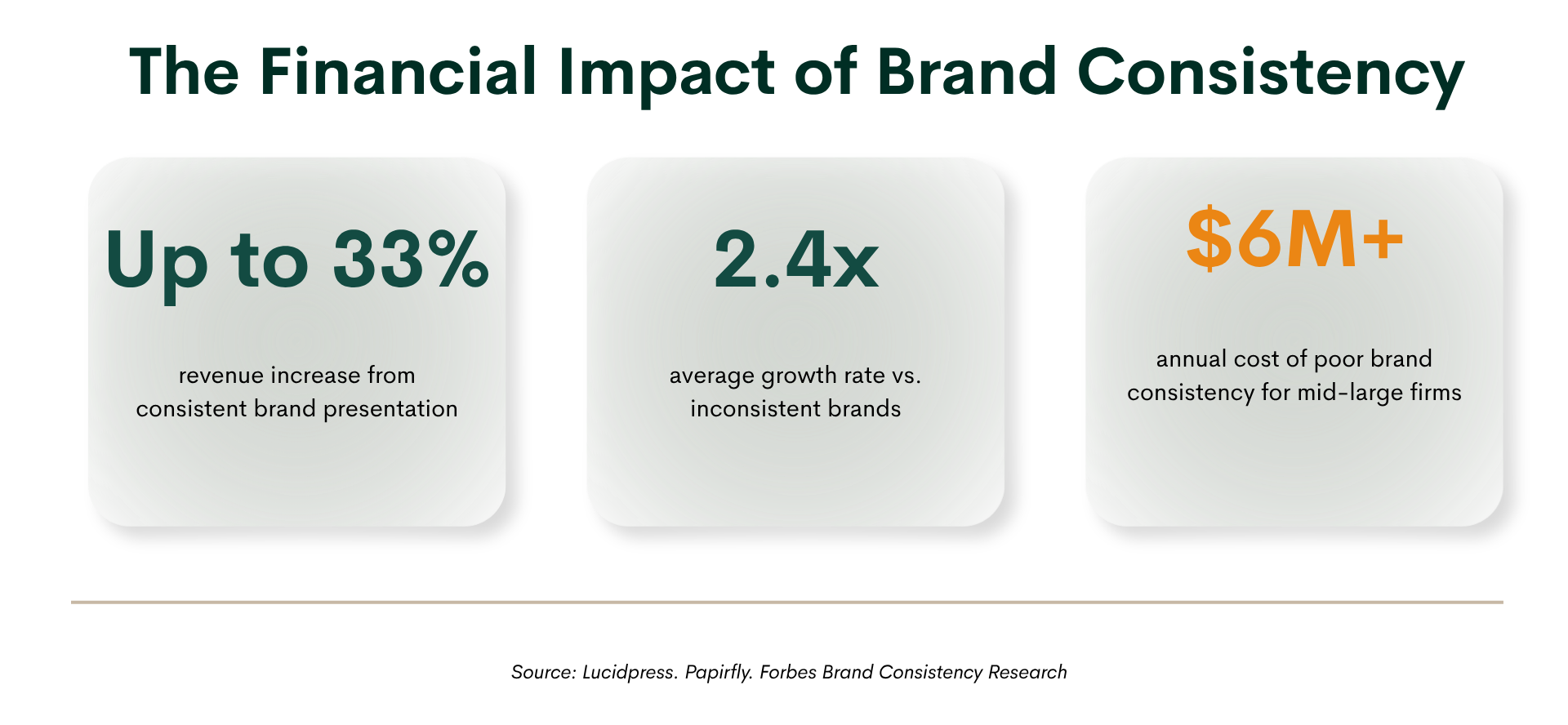
Research from Papirfly shows that 46% of enterprises report wasting budget recreating assets because of poor digital asset management — teams rebuilding materials that already exist because they cannot find or trust the originals.
Across multiple studies, consistent brand presentation is associated with revenue increases of between 10% and 33%. Companies with high brand consistency scores achieve 2.4 times the average growth rate of inconsistent brands.
There are structural reasons why professional services firms find brand consistency difficult — and most of them are not the firm’s fault.
The primary challenge is that materials are produced across different people, different tools, and different timelines. A proposal might be built in PowerPoint by a senior consultant who has not opened the brand guidelines since they were published two years ago. A one-pager might be created in Word by an operations manager adapting an old template. A LinkedIn post written by a partner with no design support.
Without a system that makes consistency the path of least resistance — templates that are actually usable, guidelines that are specific and findable, asset libraries that are current — the brand will drift. Not from negligence, but from the simple reality of how work gets done.
The shift from brand identity to brand system is primarily a structural one. It requires three things.
First, templates that are genuinely ready to use. Not design files that require a designer to unlock, but properly formatted, production-ready document templates for every format the firm regularly produces — proposals, reports, presentations, one-pagers, email signatures.
Second, guidelines that answer real questions. Not a PDF that shows the logo on different backgrounds, but documentation that tells someone exactly what to do when creating a specific type of material. How should a proposal header look? What is the correct font size for a case study headline? Which images work and which do not?
Third, a single source of truth. A location where the current, approved assets live — and where teams know to go first.
This is not a large or expensive undertaking for most firms. But it requires treating brand consistency as an operational matter, not an aesthetic one. The firms that do this well are not the ones with the most beautiful brands. They are the ones whose brands work the same way everywhere — and whose prospects feel that coherence before they ever schedule a call.